Carlos Delgado
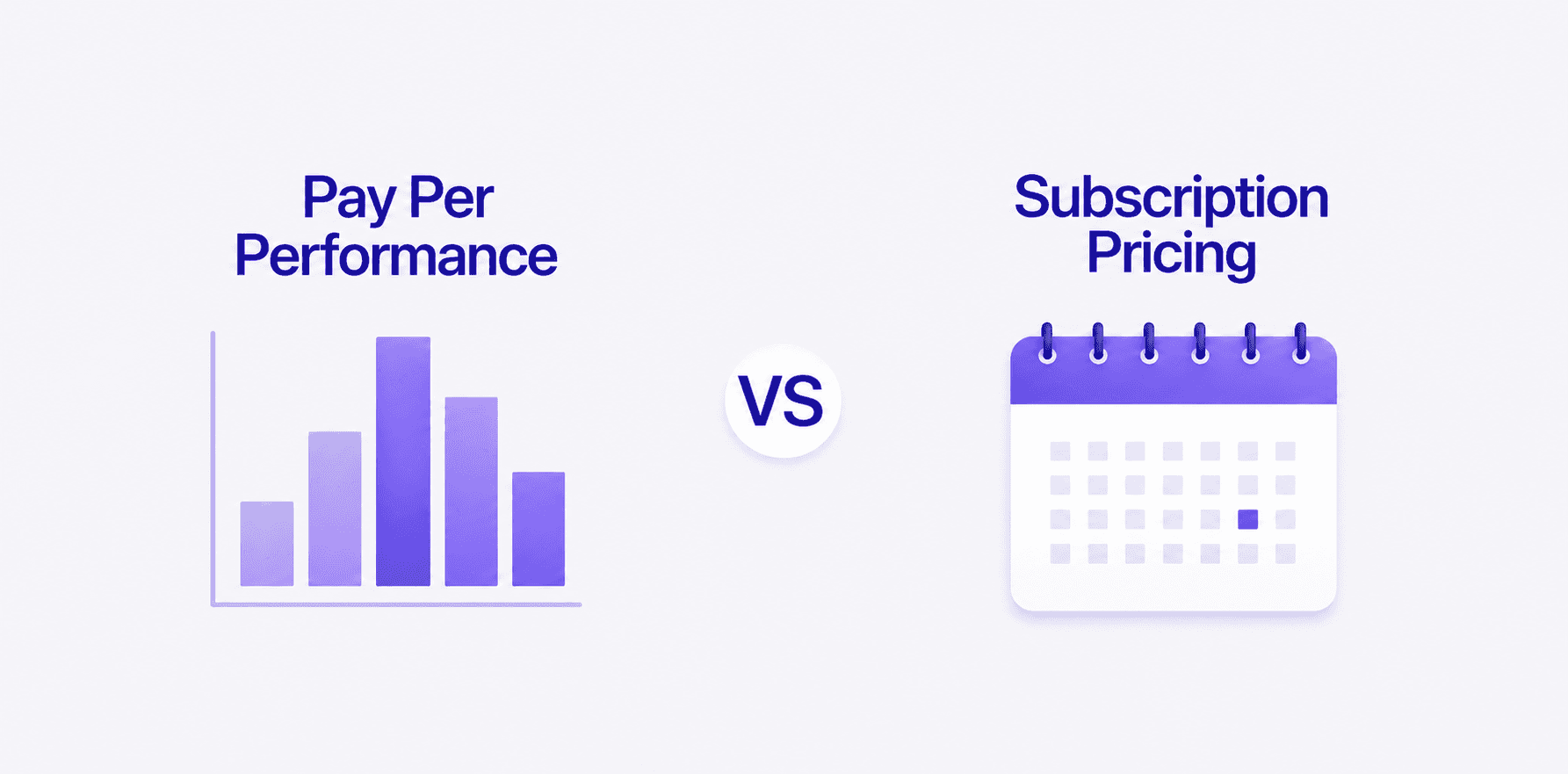
Pay per performance AI and subscription-based AI are two fundamentally different ways of paying for AI automation. With a subscription model, you pay a fixed monthly fee regardless of what the AI delivers. With pay per performance, you pay only when the AI produces a defined outcome, a qualified lead, a booked appointment, a completed conversation.
The model you choose determines how risk is distributed between you and the vendor, how quickly you can evaluate results, and how tightly the vendor's incentives are aligned with yours. For businesses investing in AI agents for sales, lead generation, or customer communication, the pricing model matters as much as the technology itself.
Quick Answer
Pay per performance AI charges you based on outcomes (qualified leads, booked appointments, or completed conversions) rather than a flat monthly fee. Subscription AI charges a fixed amount regardless of results. Pay per performance is lower risk for businesses that want results before committing to ongoing costs, and it aligns the vendor's incentives with yours. Subscription models offer more predictable costs and are typically better suited to established, high-volume use cases where performance is already proven. For most B2C businesses deploying AI agents for the first time, pay per performance reduces financial exposure and creates a clearer path to ROI.
What Is Pay Per Performance AI?
Pay per performance AI is a pricing model where you pay the AI vendor only when a specific, agreed outcome is delivered. The outcome is defined upfront and is directly tied to business value: a lead that meets your qualification criteria, an appointment that is booked and confirmed, a customer query that is resolved without human intervention.
The vendor assumes the performance risk. If the AI agent does not deliver the agreed outcomes, you do not pay. This is different from paying for access to a tool and hoping it performs, with pay per performance, the commercial relationship only works if the AI actually works.
Common outcome definitions in pay per performance AI contracts:
Per qualified lead: A lead that meets defined criteria (intent level, budget range, service interest)
Per booked appointment: A confirmed booking in your calendar, initiated by the AI agent
Per completed conversation: A conversation that reaches a defined end state (qualification complete, information provided, issue resolved)
Per conversion: A lead that progresses to a paid customer or signed contract
The outcome definition is the most important part of a pay per performance agreement. Vague definitions create disputes; specific, measurable definitions create alignment.
What Is Subscription-Based AI?
Subscription-based AI charges a fixed monthly or annual fee for access to the platform, regardless of how many leads are qualified, how many appointments are booked, or how many conversations are resolved. You pay for the capability, not the outcome.
Subscription models are the standard across most SaaS categories, including AI platforms. They offer predictability for both sides: the vendor has recurring revenue, and the customer has a known cost. The trade-off is that the vendor's incentive is to retain the subscription, not necessarily to maximise the customer's results.
Common subscription AI structures:
Flat monthly fee: One price for access to the platform, regardless of usage or results
Tiered by volume: Pricing that scales with the number of contacts, messages, or conversations
Tiered by features: Lower tiers for basic functionality, higher tiers for advanced AI, integrations, and analytics
Per seat: A fee per human agent using the platform, independent of AI performance
Pay Per Performance AI vs Subscription: Key Differences
Risk Distribution
With a subscription model, the risk sits entirely with the buyer. You pay the monthly fee whether the AI delivers or not. If the platform underperforms, you absorb the cost.
With pay per performance, risk is shared. The vendor only earns revenue when outcomes are delivered. If the AI does not perform, the vendor does not get paid. This fundamentally changes the nature of the vendor relationship, from a software sale to a results partnership.
Cost Predictability
Subscription models offer cost predictability. You know exactly what you will pay each month, making budgeting straightforward.
Pay per performance costs fluctuate with volume. In a high-lead month, costs are higher, but so are outcomes. In a slow month, costs are lower. For businesses with variable lead volume or seasonal patterns, this variability can be an advantage or a challenge depending on cash flow.
Time to Value
Subscription models often involve a longer setup and optimisation period before meaningful results appear. You pay during that ramp-up phase regardless of output.
Pay per performance models create pressure on the vendor to deliver results quickly, because they only earn once outcomes are produced. This typically shortens time to value.
When Pay Per Performance AI Makes More Sense
You are deploying AI for the first time: When you have no baseline for what the AI should deliver, paying for outcomes reduces the risk of committing to a monthly fee for a tool that may take months to optimise.
Your lead volume is variable: If your inbound lead volume fluctuates by season, campaign, or market, a fixed subscription may mean overpaying during slow periods or being constrained during peaks.
You want vendor accountability: Pay per performance creates a contractual relationship where the vendor is invested in your results. If you want a partner rather than a software vendor, this model forces that dynamic.
Your conversion metrics are well-defined: Pay per performance works best when you have a clear, measurable outcome to pay against. If you can define what a "qualified lead" or "booked appointment" means for your business, you have what you need to structure a pay per performance agreement.
You are evaluating multiple vendors. A pay per performance model lets you run a real evaluation without paying a subscription fee during the trial period. You only pay if the AI delivers.
When Subscription AI Makes More Sense
You have high, consistent volume: If your lead flow is large and predictable, subscription pricing typically becomes more cost-efficient than per-outcome fees at scale.
You need broad platform capabilities: Subscription platforms often include more features: campaign management, analytics dashboards, multi-channel support, and integrations that go beyond a single AI agent use case. If you need the full platform, subscription may offer more value.
Your team manages the AI internally: Subscription platforms are usually self-serve: your team builds, manages, and optimises the flows. If you have the technical capacity to do this well, subscription gives you more control.
You are adding AI to an existing workflow: If AI is one component of a broader platform you are already using, a CRM, a customer support tool, a marketing automation platform, subscription pricing for that integrated AI capability is often the only option available.
Pay Per Performance AI in WhatsApp Automation
For B2C businesses using AI agents on WhatsApp, for lead qualification, appointment booking, or customer support, pay per performance is a particularly well-suited model. The outcomes are clearly defined (a booked appointment, a qualified lead), easily verified (calendar confirmation, CRM record), and directly tied to revenue.
The alternative is a subscription platform that charges a monthly fee regardless of how many appointments are booked or how many leads convert. In a high-volume B2C environment with variable lead flow, this creates a fixed cost that does not move with results.
Pay per performance on WhatsApp automation typically covers:
The AI agent build and ongoing optimisation
WhatsApp Business API access and messaging fees
CRM and calendar integration
Human handoff infrastructure
Reporting and performance monitoring
The vendor's fee is earned only when the agent delivers. If the agent books 50 appointments in a month, the vendor earns for 50 outcomes. If it books 10, they earn for 10.
Frequently Asked Questions
Is pay per performance AI better than subscription?
It depends on your situation. Pay per performance is better when you are deploying AI for the first time, when your lead volume is variable, or when you want vendor accountability tied to results. Subscription is better at high, consistent volume where per-outcome fees would exceed a flat rate, or when you need a broad platform with capabilities beyond a single AI use case. For most B2C businesses starting with AI agents, pay per performance reduces financial risk and creates clearer ROI visibility.
How is a qualified lead defined in a pay per performance AI contract?
The definition varies by business and should be agreed before the contract is signed. A qualified lead typically meets a set of criteria: a minimum intent level (expressed interest in booking or buying), a relevant service type, and sometimes a geographic or demographic qualifier. The more specific the definition, the fewer disputes arise. Confirm how qualification is verified, it should be traceable in your CRM.
Can pay per performance AI scale?
Yes. Pay per performance scales proportionally: as lead volume and bookings grow, costs grow, but so do outcomes. For businesses in growth phases, this is often preferable to a subscription that charges a fixed amount regardless of the results it drives. At very high volume, subscription models may become more cost-efficient, which is why many businesses start on pay per performance and renegotiate as scale is established.